Introduction
Lambert’s Cosine Law is one of the fundamental principles in optics, illumination engineering, physics, and computer graphics. It explains how the intensity of light observed from a surface changes depending on the viewing angle. The law was introduced by Johann Heinrich Lambert, a Swiss mathematician and physicist, in the 18th century.
This law is widely used in:
- Lighting design
- Photography
- Computer graphics
- Solar energy systems
- Optical engineering
- Radiation measurements
Understanding Lambert’s Cosine Law helps engineers and designers predict how light behaves when it strikes or leaves a surface.
What is Lambert’s Cosine Law?
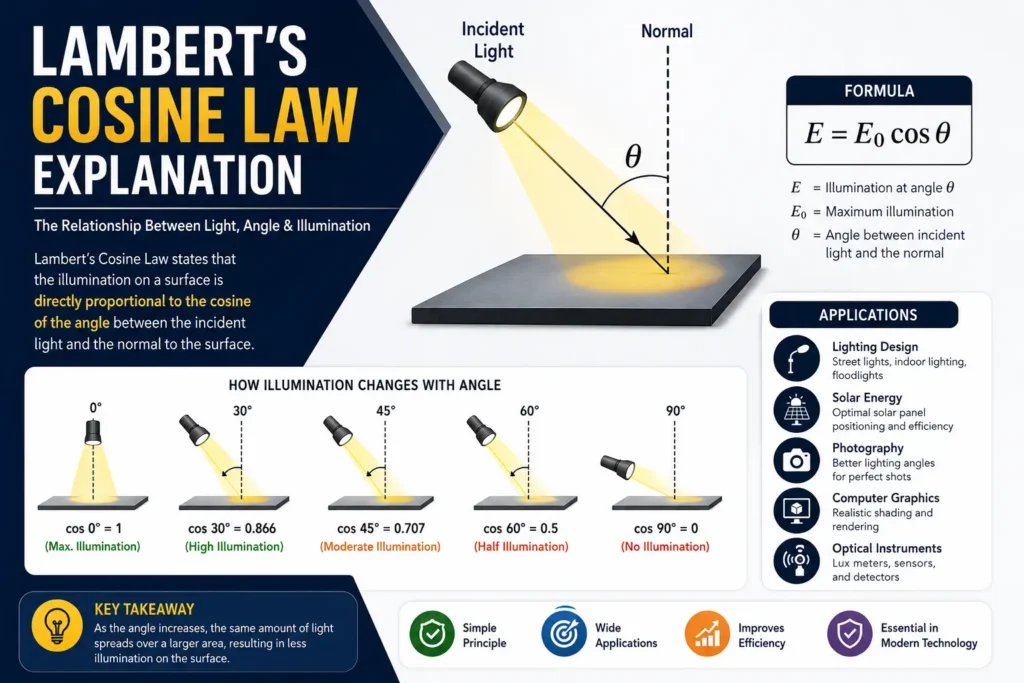
Lambert’s Cosine Law states that:
The intensity of illumination on a surface is directly proportional to the cosine of the angle between the direction of incident light and the normal to the surface.
Understanding the Concept
Imagine a flashlight shining directly on a wall.
- When the light hits the wall straight (90° to the surface), the brightness is maximum.
- As the flashlight tilts, the same amount of light spreads over a larger area.
- Because the light spreads out, the surface appears dimmer.
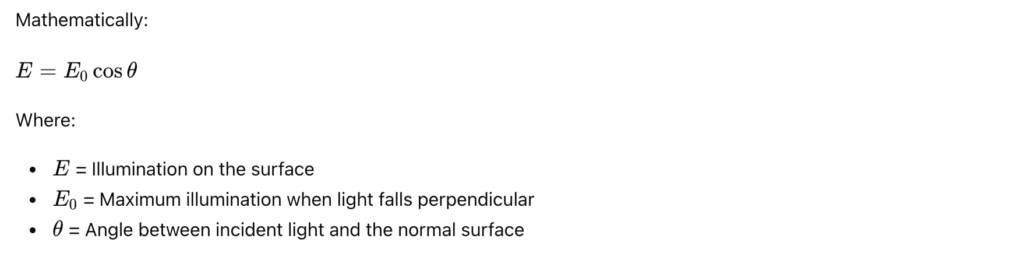
This reduction in brightness follows the cosine of the angle.
How the Cosine Relationship Works
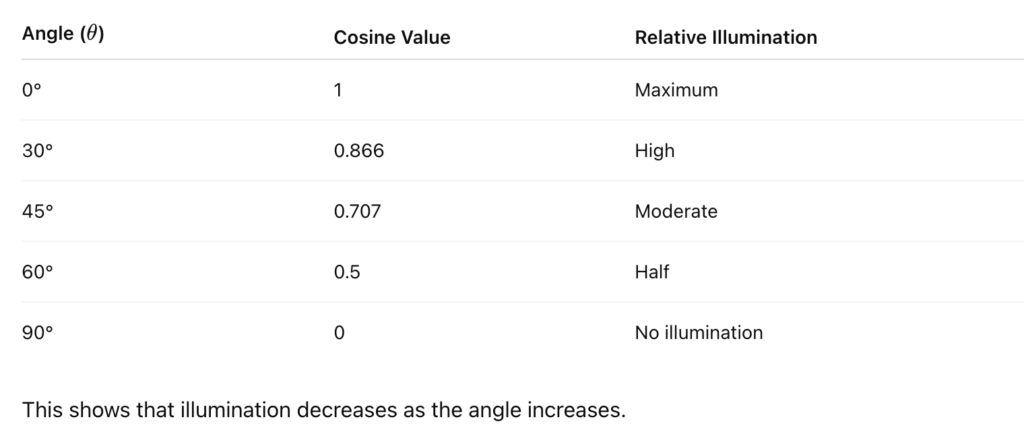
Let us see how illumination changes with angle:
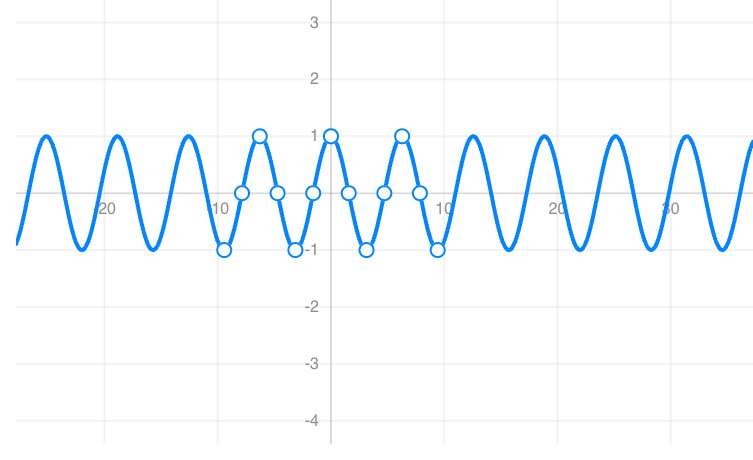
Graphical Representation
y=cos(x)
Real-Life Example
Example: Sunlight on Earth
At noon, sunlight strikes the Earth more directly.
- Angle is small
- Cosine value is high
- More heat and brightness
During sunrise or sunset:
- Sunlight strikes at a larger angle
- Cosine value decreases
- Less heat and lower brightness
This is why afternoons are usually hotter than mornings.
Applications of Lambert’s Cosine Law
1. Illumination Engineering
Used to design:
Street lights
Indoor lighting
Stadium floodlights
Industrial lighting systems
Engineers calculate proper illumination levels using the cosine law.
2. Solar Panels
Solar panels produce maximum power when sunlight falls perpendicular to the panel surface.
As the sunlight angle changes, efficiency decreases according to Lambert’s Cosine Law.
3. Photography and Cinematography
Photographers use lighting angles to:
Reduce shadows
Improve brightness
Create realistic visual effects
4. Computer Graphics
In 3D rendering and gaming, Lambert’s Law helps create realistic shading on objects.
It is commonly used in:
Diffuse reflection models
Rendering engines
Animation software
5. Optical Instruments
Used in:
Lux meters
Radiation sensors
Scientific instruments
Lambertian Surface
A surface that perfectly follows Lambert’s Cosine Law is called a Lambertian Surface.
Characteristics:
- Appears equally bright from all viewing directions
- Reflects light uniformly
- Ideal diffuse reflector
Examples:
- Matte white paint
- Chalk surface
- Paper
Advantages of Lambert’s Cosine Law
- Simple mathematical model
- Useful in lighting calculations
- Helps optimize energy efficiency
- Essential in optical system design
- Improves realistic rendering in graphics
Limitations
Lambert’s Cosine Law works best for ideal diffuse surfaces.
It may not accurately describe:
- Glossy surfaces
- Mirror reflections
- Metallic materials
- Highly polished objects
Such materials require more advanced reflection models.
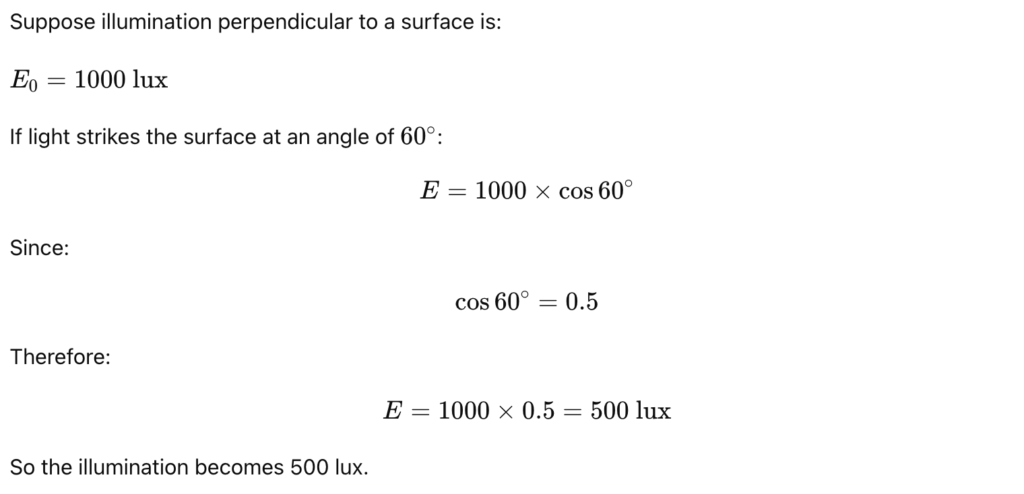
Numerical Example
Conclusion
Lambert’s Cosine Law is a fundamental principle that explains how illumination changes with angle. It plays a vital role in lighting engineering, solar technology, photography, and computer graphics.
The law helps engineers and scientists design efficient systems by understanding how light spreads over surfaces. Even though it is a simple law, its applications are vast and extremely important in modern technology.
Understanding Lambert’s Cosine Law provides a strong foundation for studying optics, illumination, and light behavior in real-world systems.