
Introduction
Have you ever wondered why:
- Ice melts on a warm day but water never freezes by itself at room temperature?
- A drop of perfume spreads throughout an entire room?
- Hot tea cools down naturally, but cold tea never becomes hot on its own?
- A tidy room becomes messy over time unless someone cleans it?
Although these situations seem unrelated, they all have one thing in common—they are governed by entropy.
Entropy is one of the most important concepts in thermodynamics because it helps explain why natural processes occur in a particular direction. It tells us why some changes happen spontaneously while others require external work.
Many students memorize that “entropy is a measure of disorder,” but this definition is only partially correct. Modern physics explains entropy in a much deeper and more meaningful way.
In this article, we will understand entropy from the ground up, explore its physical meaning, and see how it is connected to the Third Law of Thermodynamics, all without relying on complicated mathematics.
What is Entropy?
Entropy is a property of a system that describes how energy is distributed and how many different ways the particles in the system can be arranged without changing its overall appearance.
In simple words,
Entropy measures the degree of randomness and the number of possible arrangements of particles in a system.
Another easy way to understand entropy is:
The more freely particles can move and arrange themselves, the higher the entropy.
Entropy does not mean chaos in the everyday sense. Instead, it reflects the number of microscopic possibilities available to a system.
Mathematical Definition
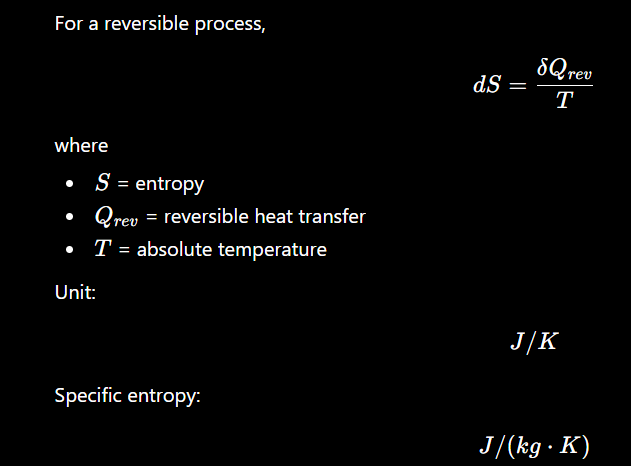
Why Was Entropy Introduced?
Scientists studying heat engines noticed that although energy is conserved, not all energy can be converted into useful work.
Some energy always becomes unavailable for doing useful work.
To explain this limitation, the German physicist Rudolf Clausius introduced the concept of entropy in 1865.
Later, Ludwig Boltzmann explained entropy from a microscopic point of view by connecting it with the arrangement of atoms and molecules.
Understanding Entropy Through Real-Life Examples
1. A Clean and a Messy Room
Imagine two rooms.
In the first room, every book is neatly arranged, every chair is in its proper place, and everything looks organized.
In the second room, books are scattered everywhere, clothes are on the bed, and papers cover the floor.
Which room can be arranged in more different ways?
The messy room.
There are countless ways for a room to become messy but only a few ways for it to remain perfectly organized.
Therefore, the messy room has higher entropy.
This example illustrates why systems naturally move toward states with more possible arrangements.
2. Perfume in a Room
Suppose you spray perfume in one corner of a room.
Initially, the perfume molecules are concentrated in a small region.
After a few minutes, the fragrance spreads throughout the room.
Why?
Because the molecules now have much more space to move and many more possible arrangements.
The reverse process—where all perfume molecules gather back into the bottle by themselves—never happens naturally because it is extraordinarily improbable.
Entropy increases because the molecules become more dispersed.
3. Melting Ice
When ice melts,
- water molecules become less restricted,
- they move more freely,
- and they can occupy many more positions.
Therefore,
Entropy increases during melting.
4. Water Turning into Steam
Steam molecules move much more freely than liquid water molecules.
A gas occupies the entire container instead of remaining confined like a liquid.
Because gas molecules have many more possible arrangements, steam has much higher entropy than liquid water.
Entropy in Solids, Liquids, and Gases
Different states of matter have different entropy values.
Solids
In solids, atoms are tightly packed and can only vibrate about fixed positions.
Since their movement is limited, there are relatively few possible arrangements.
As a result, solids have low entropy.
Liquids
In liquids, molecules can move past one another.
They have more freedom than in solids.
Therefore, liquids have higher entropy than solids.
Gases
Gas molecules move freely in all directions and occupy the entire container.
They have an enormous number of possible arrangements.
Therefore, gases have the highest entropy among the three common states of matter.
Why Does Entropy Increase Naturally?
Nature always favors the most probable state.
Imagine releasing thousands of tiny balls inside a large room.
Eventually, they spread throughout the room instead of remaining crowded in one corner.
Why?
Because there are far more ways for the balls to be spread out than to stay together.
The same principle applies to atoms and molecules.
Systems naturally move toward states that have the greatest number of possible arrangements.
Entropy and Temperature
Temperature greatly affects entropy.
When temperature increases,
- particles move faster,
- vibrations become stronger,
- molecules rotate more,
- and they gain greater freedom of movement.
As a result, the number of possible arrangements increases.
Therefore,
Higher temperature usually means higher entropy.
Can Entropy Ever Decrease?
Yes.
The entropy of a particular system can decrease.
For example,
- water freezes into ice,
- steam condenses into water,
- crystals form from molten materials.
In these cases, particles become more organized.
However, these processes release heat to the surroundings.
The increase in the surroundings’ entropy is larger than the decrease in the system’s entropy.
As a result,
the total entropy of the universe still increases.
This is one of the central ideas of thermodynamics.
Entropy and the Third Law of Thermodynamics
The Third Law of Thermodynamics states:
The entropy of a perfect crystal is zero at absolute zero temperature (0 K).
This statement may sound surprising at first.
To understand it, imagine cooling a perfect crystal continuously.
As the temperature decreases,
- atomic vibrations become weaker,
- molecular motion decreases,
- particles lose thermal energy,
- and eventually, at absolute zero, they occupy fixed positions in a perfectly ordered arrangement.
At this point,
there is only one possible arrangement of the atoms.
Since there is no randomness and no alternative arrangement,
the entropy becomes zero.