Latest Most Asked Interview Questions for Physics Assistant Professor

Introduction

An Assistant Professor interview in Physics is designed to evaluate much more than your theoretical knowledge. Interview panels assess your conceptual understanding, teaching methodology, communication skills, research aptitude, and ability to explain complex ideas in a simple and engaging way.

Unlike written examinations, interviews often include logical, conceptual, application-based, and cross-disciplinary questions. Interviewers may ask questions from any branch of physics, including classical mechanics, quantum mechanics, thermodynamics, statistical mechanics, optics, lasers, electromagnetism, electronics, solid-state physics, nuclear physics, and modern physics. They may also ask how you would teach a topic, relate physics to everyday life, or connect concepts across different domains.

This comprehensive guide contains 100+ of the latest and most frequently asked physics interview questions with detailed answers, specially prepared for:

  • Assistant Professor interviews
  • State Eligibility Test (SET) interviews
  • College and university faculty recruitment
  • Engineering Physics faculty interviews
  • Polytechnic lecturer interviews
  • B.Sc. and M.Sc. Physics viva examinations

General Introduction Questions

1. Tell us about yourself.

Sample answer:

“I have completed my postgraduate studies in Physics with a strong interest in teaching and research. My academic interests include Statistical Mechanics, Engineering Physics, Quantum Mechanics, Solid State Physics, and Laser Physics. I enjoy explaining difficult concepts using real-life examples and demonstrations. My teaching philosophy focuses on conceptual understanding rather than memorization. I believe that a good teacher inspires curiosity and develops scientific thinking among students.”

2. Why do you want to become an Assistant Professor?

Teaching allows me to share my knowledge while continuously learning through interaction with students. I enjoy simplifying difficult concepts and motivating students to develop analytical thinking. Along with teaching, I also wish to contribute to research, curriculum development, and mentoring future scientists and engineers.

3. What qualities make an excellent physics teacher?

An excellent physics teacher should have:

  • Strong conceptual understanding
  • Effective communication skills
  • Patience and enthusiasm
  • Practical demonstration skills
  • Research orientation
  • Ability to motivate students
  • Continuous learning attitude
  • Problem-solving ability

4. How would you teach a difficult topic?

I follow four steps:

  1. Begin with an everyday-life example.
  2. Explain the physical concept intuitively.
  3. Introduce mathematical equations gradually.
  4. Solve numerical problems and conduct demonstrations.

Conceptual Physics Questions

1. If atoms are mostly empty space, why don't we pass through walls?

Although atoms are mostly empty space, the electrons in our body and the electrons in the wall strongly repel each other due to electromagnetic forces. Additionally, the Pauli Exclusion Principle prevents identical fermions (such as electrons) from occupying the same quantum state. These effects stop us from passing through solid objects.

2. Why is the sunset red?

At sunrise and sunset, sunlight travels through a longer path in the atmosphere. Most of the blue light is scattered away before reaching the observer, leaving mainly red and orange wavelengths.

3. Why is the sky blue?

The sky appears blue because of Rayleigh scattering. Air molecules scatter shorter wavelengths (blue and violet) much more effectively than longer wavelengths (red). Since our eyes are more sensitive to blue light and some violet light is absorbed in the upper atmosphere, we perceive the sky as blue.

4. Why do stars twinkle but planets do not?

Stars are so distant that they appear as point sources. Atmospheric turbulence continuously changes the direction of their light, causing fluctuations in brightness (twinkling). Planets appear as small discs, so these fluctuations average out.

5. Why do astronauts experience weightlessness?

Astronauts are continuously falling toward Earth along with their spacecraft. Since both experience the same gravitational acceleration, they appear weightless relative to each other. This condition is called apparent weightlessness or microgravity

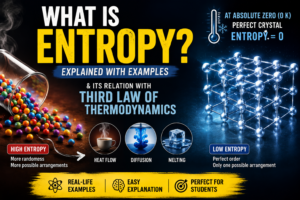
6. What is entropy?

Entropy is a measure of the randomness or disorder of a system. It also indicates the number of microscopic arrangements (microstates) corresponding to a macroscopic state.

7. Can entropy decrease?

Yes, entropy of a subsystem can decrease if the total entropy of the universe increases. However, for an isolated system, entropy never decreases according to the Second Law of Thermodynamics.

8. What is quantum tunneling?

Quantum tunneling is the phenomenon in which a particle has a finite probability of passing through a potential barrier even when its energy is less than the barrier height.

9. Why is population inversion necessary?

Without population inversion, absorption dominates stimulated emission. Population inversion ensures that stimulated emission exceeds absorption, enabling optical amplification.

10. What is the Fermi level?

The Fermi level is the highest occupied energy level at absolute zero. It determines the electrical behavior of solids.

11. What is an ensemble? What are its types?

An ensemble is a large collection of hypothetical systems, each having the same macroscopic properties (such as volume, pressure, and temperature) but differing in their microscopic states. The concept of an ensemble was introduced by J. Willard Gibbs to simplify the statistical study of thermodynamic systems.

Since it is impossible to track every particle in a real system, statistical mechanics studies the average behaviour of an ensemble instead of a single system.

Types of Ensembles

1. Microcanonical Ensemble (N, V, E)

  • Number of particles (N), Volume (V), and Energy (E) remain constant.
  • No exchange of energy or matter with the surroundings.
  • Represents an isolated system.

Example: Gas enclosed in a perfectly insulated rigid container.


2. Canonical Ensemble (N, V, T)

  • Number of particles and volume remain constant.
  • Temperature is constant because the system exchanges energy with a heat reservoir.
  • Energy fluctuates.

Example: A closed container kept in a constant-temperature water bath.


3. Grand Canonical Ensemble (μ, V, T)

  • Temperature and volume remain constant.
  • Both energy and particles can be exchanged with the surroundings.
  • Number of particles fluctuates.

Example: Gas in an open container connected to a particle reservoir.

12. What is probability density in quantum mechanics?

In quantum mechanics, the exact position of a particle cannot be predicted. Instead, we calculate the probability of finding the particle at a particular position.

If ψ(x, t) is the wave function, then the probability density is

probability density

where ψ* is the complex conjugate of the wave function.

The probability density gives the probability per unit volume of finding the particle at a given position.

The probability of finding the particle between x and x + dx is

probability of finding particle

Physical significance

  • The wave function itself has no direct physical meaning.
  • Only |ψ|² is measurable.
  • The total probability must always be equal to 1.

Therefore,

normalisation condition

This is known as the normalization condition.

13. What is the difference between Maxwell–Boltzmann (MB), Bose–Einstein (BE), and Fermi–Dirac (FD) distributions?

These three statistical distributions describe how particles occupy energy states under different physical conditions.

FeatureMaxwell–Boltzmann (MB)Bose–Einstein (BE)Fermi–Dirac (FD)
Particle typeClassical particlesBosonsFermions
SpinAny (classical limit)Integer (0, 1, 2, …)Half-integer (½, 3/2, …)
IndistinguishableNoYesYes
Pauli Exclusion PrincipleNot applicableNot applicableObeys Pauli exclusion principle
Maximum particles in one stateUnlimitedUnlimitedOnly one particle per quantum state (per spin state)
Typical examplesGas moleculesPhotons, phonons, helium-4 atomsElectrons, protons, neutrons

About Us

Welcome to our Physics Blog! We’re excited to take you on a journey through the fascinating world of physics, where we’ll unravel the mysteries of the universe, one topic at a time. Physics is the science that underpins everything in the natural world. It’s the key to understanding the behavior of matter, energy, and the forces that shape our reality.

Recent Posts